Introduction:
Crypto investigation is the process of tracing blockchain transactions, identifying wallet activity, and analyzing digital asset movements to uncover fraud, scams, and financial crimes. As cryptocurrency adoption increases, the need for structured investigation methods has become essential for victims, investors, and professionals.
Why Crypto Investigations Matter More Than Ever
The reality is very different.
Blockchain transactions are permanent, transparent, and highly traceable when analyzed correctly. This has led to the rise of blockchain forensics — a field focused on tracking digital assets, identifying patterns, and uncovering the entities behind transactions.
Crypto investigations today are used by:
- Blockchain forensic analysts
- Law enforcement agencies
- Cryptocurrency exchanges
- Compliance and AML teams
- Legal professionals handling digital asset disputes
This guide combines forensic principles, tools, and real-world methodologies into one complete resource designed for beginners, investors, and advanced users.
Understanding Bitcoin Traceability
Bitcoin operates on a public ledger where every transaction is recorded and cannot be altered. This creates a powerful foundation for investigation.
Transparency
Every transaction is visible on the blockchain. Anyone can trace the movement of funds from one wallet to another using publicly available tools.
Pseudonymity
Bitcoin is not anonymous. Wallet addresses act as identifiers, but they do not directly reveal identities unless linked to external data.
A key principle to understand:
Transactions are permanent, but identities are inferred — not directly known.
Immutability
Once a transaction is confirmed, it cannot be reversed. This ensures data integrity but also means that prevention and rapid response are critical.
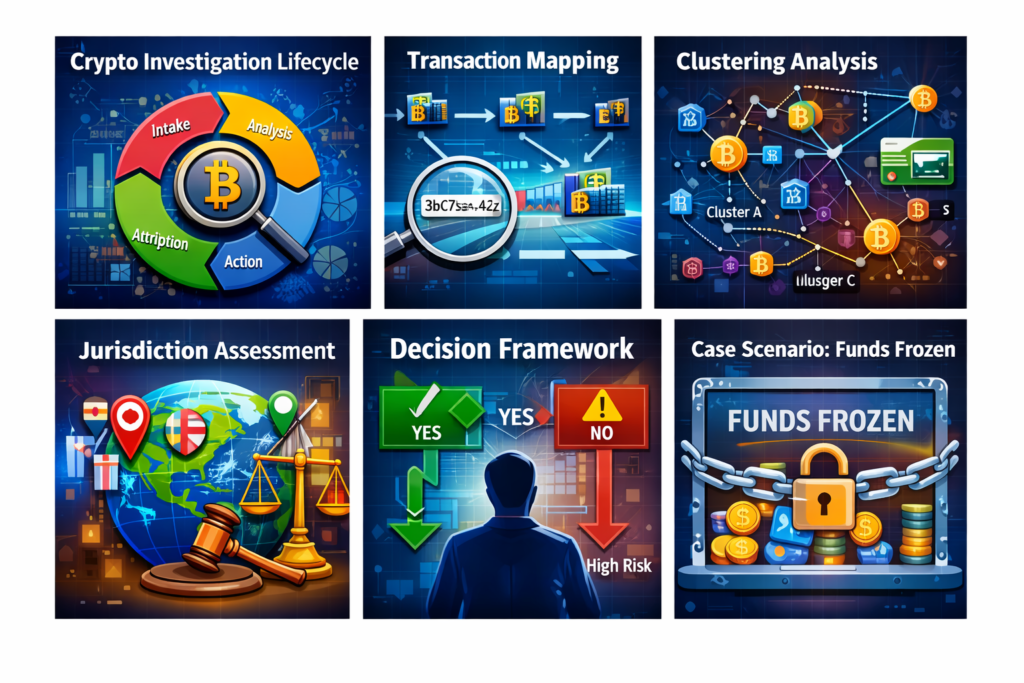
The Blockchain Investigation Lifecycle
A professional crypto investigation follows a structured process. Skipping steps often leads to incomplete or incorrect conclusions.
1. Intake
This is where everything begins. Accurate data collection is critical.
You need:
- Transaction ID (TXID)
- Wallet address
- Timeline of events
The more precise the data, the stronger the investigation.
2. Analysis
At this stage, investigators trace the movement of funds across the blockchain.
They:
- Follow transaction paths
- Identify how funds are split or combined
- Build a map of wallet interactions
This creates a clear picture of how assets move.
3. Attribution
This is where blockchain data meets real-world identity.
Investigators attempt to link wallets to:
- Cryptocurrency exchanges
- Payment platforms
- Online services
- Individuals (when possible)
Attribution is the most critical and most challenging stage.
4. Action
Once sufficient evidence is gathered, action is taken:
- Reporting to exchanges
- Submitting freeze requests
- Legal escalation
- Law enforcement involvement
Timing plays a major role in success.
Step-by-Step Crypto Investigation Process
Step 1: Case Intake
Every investigation starts with collecting key data.
This includes transaction IDs, wallet addresses, and a timeline of events. Supporting evidence like screenshots or communication logs can significantly strengthen the case.
Step 2: Transaction Mapping
Funds are traced from the origin wallet through multiple transactions.
Investigators identify:
- Transaction chains
- Wallet interactions
- Splitting and consolidation patterns
This is where the flow of funds becomes visible.
Step 3: Clustering Analysis
Wallets are grouped based on behavior and transaction patterns.
This helps determine:
- Whether multiple wallets belong to the same entity
- How funds are controlled and distributed
Clustering turns scattered data into meaningful networks.
Step 4: Attribution
At this stage, investigators connect wallets to known entities.
This may involve:
- Identifying exchange deposit addresses
- Matching wallets to known services
- Using external intelligence sources
Attribution is what makes recovery possible.

Step 5: Jurisdiction Assessment
Not all cases can be acted on equally.
Investigators assess:
- Where funds are held
- Whether the platform is regulated
- If cooperation is possible
Jurisdiction determines what actions can realistically be taken.
Step 6: Action Phase
Based on findings, actions may include:
- Reporting to exchanges
- Requesting account freezes
- Filing legal complaints
- Engaging law enforcement
Speed is critical at this stage.
Crypto Tracing Toolkit: Tools Professionals Use
No single tool is enough. Professionals combine multiple tools for accuracy.
Blockchain Explorers
Used for initial tracing and verification of transactions.
They provide:
- Transaction details
- Wallet history
- Real-time data
Advanced Analytics Platforms
These tools provide deeper insights through clustering and risk analysis.
They help:
- Identify wallet ownership patterns
- Detect links to known entities
- Assign risk scores
OSINT & Attribution Tools
Open-source intelligence tools are used to investigate external connections.
This includes:
- Domain lookups
- Scam database checks
- Social footprint analysis
Address Intelligence Sources
These databases label known wallet addresses.
They identify:
- Exchanges
- Scam wallets
- Services and platforms
Transaction Monitoring Tools
Used to track funds in real time.
They:
- Monitor wallet activity
- Send alerts when funds move
- Help act quickly
Cross-Chain Tracking Tools
Criminals often move funds across blockchains.
These tools help track:
- Bridge transactions
- Multi-chain activity
- Asset conversions
This process involves the use of advanced tools similar to ETHERSCAN: https://etherscan.io which enable our investigators to determine where the stolen Bitcoin has moved and whether it has reached a recoverable point.
Decision Framework: Can Crypto Be Recovered?
This is one of the most important questions.
Recovery Is Possible When:
- Funds reach a regulated exchange
- The exchange has KYC data
- The case is reported quickly
- Clear evidence is available
Recovery Is Unlikely When:
- Funds are heavily mixed
- Privacy coins are used
- Assets move through multiple chains
- Jurisdictions do not cooperate
Understanding this helps set realistic expectations.
Common Challenges in Crypto Investigations
Mixing Services
These are designed to obscure transaction trails and complicate tracing.
Time Delays
The longer it takes to start an investigation, the harder it becomes to track funds.
False Attribution
Incorrect conclusions can damage a case. Verification is critical.
Real-World Case Scenario
A victim sends Bitcoin to what appears to be a legitimate investment platform.
Shortly after:
- Funds are moved across multiple wallets
- Transactions are split and recombined
- Assets are consolidated into a single wallet
Further tracing reveals the funds were sent to a cryptocurrency exchange.
At this point:
- The exchange is identified
- A report is submitted with transaction evidence
- A freeze request is initiated
If acted on quickly, there is a chance the funds can be intercepted before withdrawal.
This scenario reflects how most real-world investigations unfold.
Ethical and Legal Considerations
Blockchain investigations must be handled responsibly.
Privacy
Public data does not justify making unsupported identity claims.
Legal Compliance
Investigations must follow applicable laws and regulations.
Evidence Handling
All findings should be documented clearly and preserved for legal use.
When to Seek Professional Help
Some cases quickly become too complex for individuals.
You should consider professional support when:
- Funds move across multiple wallets or chains
- Attribution is unclear
- Exchanges or legal processes are involved
- You need structured reporting
Professional investigators have access to advanced tools, experience, and methodologies that improve the chances of meaningful outcomes.
For expert crypto investigation and tracing support, visit:
https://cryptorecoveryminions.com
Final Disclaimer
Blockchain analysis can reveal transaction flows and potential attribution. However, no investigation guarantees recovery.